The Day With 'Auntie'

The Day With 'Auntie'
In the photo, clockwise from top left: Emma, Wei Wen, Ee Von, Leo and Auntie Latifah
Showing posts with label Dusun Tua. Show all posts

Wednesday, 4 September 2013

CHAPTER 3.3: Traditional Malay House Activities

Ciao, again. We're back with the activities inside the house, as promised, viewer discretion is advised, be warned.


The various activities throughout the house
As what we did for the kedai runcit, we did it for this house to show the activities more clearly.

1. Rumah ibu - although not common in traditional Malay houses, the rumah ibu here is converted to a living and sleeping area since there is only one occupant in the house.

2. Rumah dapur - typically a well ventilated kitchen area which incorporates the dining area to reduce fuss.

3. Bathroom - simple extension of the house to allow hygienic dispositions.

4. Water closet - presumably an outhouse in the past (now slightly modernized) to allow necessary bowel movements and such.

5. Rumah ibu (again, this is not a typo) - since she lives alone, she has a large space to herself in the rumah ibu, in which she uses also as a praying area.

To simply put it, the traditional Malay house was built for essentiality and comfort which is apparent to us when we visited the house as it was perfectly habitable without the excessive gadgets of modern day.

And this ends our third chapter. The commencement of the next chapter would probably be up soon enough so reread the blog until we come back with new materials. Goodbye!

Tuesday, 3 September 2013

CHAPTER 3.2: The Traditional Malay House and Its Relationships

Auntie and what makes her happy
After explaining the rituals and customs related to the traditional Malay house, we now arrive to the topic of an actual house we found in Dusun Tua. As mentioned in previous posts, the house we've visited and studied on belongs to an old lady we know as Ms. Latifah (she's not married), but we'll just call her auntie.


The traditional Malay house with its surrounding elements
Referring to the image above, the houses within the compound area are surrounded by various types of fruiting trees like bananas (I), coconuts (II), mangoes and jack fruits (III), durians (IV) as well as the pandans (VI) that are tended to daily by the auntie as mentioned back in Chapter One.


A view of the compound from across the main road
To walk you through, the first thing you'll see of the compound would be the trees and plants at point (1) that acts a privacy barrier, semi-concealing the buildings and activities in the compound. The plants and trees in the compound also serves to set a physical boundary between neighboring lands that are owned by different people. There is also a hardware factory (D) next to the compound.


Walking in
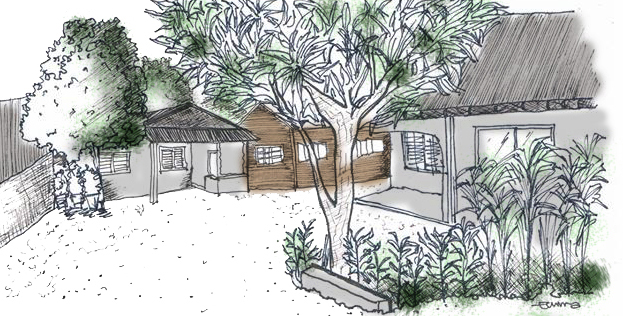
Stepping into the compound at point (2), you will see two brick houses (A) owned by the auntie's siblings and a glimpse of the timber house (B).


Outlook of the house
Going further into this private property at point (3), you will finally be able to see the full view of the traditional Malay house that is now slowly going into ruins due to the damage done by serious flooding issues and the rare maintenance of the building. 


The spaces found in the house
Zooming into the house itself, the spaces of a traditional house are generally arrange in a similar manner where the anjung (covered porch) will welcome visitors into the rumah ibu (main house) which is usually connected to the rumah dapur (kitchen) that is access by mostly the women of the house through the terrace from the back.


The house as view from the front
Visitors enter the house through the anjung which is raise above ground level to avoid mild flooding and to keep the house cool. According to the auntie, the house always had a zinc roof which was recently replaced with a newer ones, contrary to our belief that all traditional Malay houses have atap or thatched roof that are usually made from the nipah palm leaves.  


Longitudinal section of the house
As the house is pretty much lived in by only the auntie herself, the rumah ibu functions as her living room as well as bedroom as there are rarely anybody else around. The slits on the wall of the rumah dapur functions as a ventilation path as well as a protector from heavy rainfall.

The next part would be on the activities in the house so keep checking back if you're interested. Ciao!

Monday, 19 August 2013

CHAPTER 1.2: The History of Dusun Tua

Welcome back! So as mentioned in the previous post, we'll be telling you how Dusun Tua came to be and what it has become today.

The naming of a place
So, Dusun Tua actually means 'old orchard' in Malay, and like a lot of places (think Kuala Lumpur, literally 'muddy confluence' or Pulau Pinang, 'pinang palm island') have similar naming method based on what was abundant or plentiful at a given time and it was the orchards that was making the kampung prosperous.

Heh, we have padi too
Besides fruit plantation, there was also enough land and proper irrigation for paddy plantation, which would eventually become their main food source.

Free food! well, kind of...
With land comes the purpose of sustain oneself, and with that, the people of Dusun Tua are able to grow their own food and they need not shop for food.

As always, something bad has to happen
Unfortunately, things got worst for them, flooding became a serious problem and it ruin a lot of the orchards and paddy fields.


Ta-da! And by that, we mean 'transform'
Inevitably, modernization is bound to happen, and the younger generation of Dusun Tua are now more or less part of a society yearning for a better living standard and they go after it.


This looks like ghosts moving to a cemetery but it's not, they're going to a city
With the attraction outwards the kampung, traditional means of self-sustaining is no longer viable as the older generation are probably tired and weary minus the help of the younger generation.

And today, what we see of Dusun Tua could be said to be the remnants of its former glory, there but not there, visible but invisible.

Following this post, we'll write about how the kampung is being managed by a group of people, aiming to help balance out the modernization with the traditional values of the kampung.