The Day With 'Auntie'

The Day With 'Auntie'
In the photo, clockwise from top left: Emma, Wei Wen, Ee Von, Leo and Auntie Latifah
Showing posts with label activities. Show all posts

Wednesday, 23 October 2013

CHAPTER 4.2: Recipes, Ingredients and Processes

We've mentioned making the kuah kacang (peanut sauce) previously and here are the details on how to make it. The portion we have here is for approximately 200 people, since dishes like this are commonly cooked for a large crowd of people and can be done in one go, so scale down the portion to suit your preferences.


Ingredients:
3 kg           roasted peanuts
1 kg           bawang merah (red onions)
15 sticks    serai (lemongrass)
1" piece     lengkuas (galangal)
1.5 kg        dried chilies
300 g         dried shrimp
1 pack       belacan (shrimp paste)
3 tbsp        salt
300 g         granulated sugar
1 piece      gula melaka (palm sugar)
                 cooking oil
                 water

Directions:

1. Place the dried chilies in a pot and add enough water to cover the chilies. Blanch the chilies until they soften, strain and put aside to cool. 


Chop and blend the onions, serai and lengkuas
2. Roughly chop the onions, serai and lengkuas and blend them together, adding a cup of water to the mix (or enough to ease the blending, don't worry about adding too much, the water helps soften and cook the peanuts later). Pour the mixture into a big bowl (we reused the basin) and leave aside.


Roast and blend the belacan with the dried shrimps
3. Roast the belacan either in a dry pan over medium heat or in an oven until the surface turns into a slightly darker brown. Break up the belacan into smaller bits and blend with the dried shrimp, adding water accordingly. Put the shrimp mixture aside.

4. Put a dry pot over medium heat or use an oven and roast the peanuts, as roasted as you like,  then remove and leave to cool.


Blend blanched chilies with oil and water
5. Now back to the blanched chilies. Blend the soften chilies with some water and oil (about half the amount of chilies) to break down the seed. Once done, add to the big basin of blended ingredients.


Crushed peanuts
6. Put the cooled roasted peanut into a blender and crush the peanuts. 


Heat oil and stir in blended chili and shrimp mixture
7. In a big pot, add approximately a cup of cooking oil and heat over medium heat, then add in all the blended ingredients except for the crushed peanuts. Stir and allow it to simmer for 10 minutes.


Stir in the blended peanuts and mix well
8. Add in the crushed peanuts, mix well until it boils, add two basins of water (approx. 20 cups of water) to the mixture and leave it on medium low heat. Come back to stir the mixture every half and hour or so.


Chop and add the gula melaka, salt and sugar
9. While the peanut mixture is cooking, chop the gula melaka into smaller bits. Add the gula melaka, salt and sugar to the pot after an hour.


Et voila! Initial orange sauce slowly cooked into a brown delicious sauce
10. Leave it to cook over medium-low heat, stirring occasionally. The sauce should be done when all the water added earlier in the blending process has more or less evaporated, leaving you with a sauce of thicker consistency and a darker colour.  

You now have a pot of staple traditional dish. Enjoy!

Friday, 18 October 2013

CHAPTER 4.1: Hello! Once again.

Hi all! We're finally back with some new stuff to show off and this time it's about Hari Raya Aidiladha, which was the Qurban celebration that we've mentioned back in Chapter 1. 

So here's a short intro video of what we did on the eve of the celebration and some of the people involved in helping us with the cooking of the usual celebration dishes. Enjoy.


Generally, each group is in charge of helping out in a kind of dish and we got a dish called the kuah kacang or peanut sauce, which is a staple dish easily paired with other dishes like lemangketupat or even plain rice.

While making the dish, we were, of course, lead by a few old hands who've done this a thousand times over. 


Ms. Noraishah guiding the preparation
We have Ms. Noraishah, who took us through the process of cutting, blending and cooking.


Ms. Rozita introducing the ingredients
And Ms. Rozita, who patiently explain the ingredients and how we should use it to get the best results.

There were others who helped in the cooking, but Ms. Noraishah and Ms. Rozita were the main guidance for our dish so we would like to extend our thanks again, not only to them but to all who had patiently took us under their wing. Thanks!

Tuesday, 10 September 2013

Cherating: Interior Architecture Workshop 2013

Aloha, readers! We're back from our 'workshop' in Cherating, Pahang and thought we'd shared something with you guys.

The sun, beach and fun!
We were in this beach for three days two nights, getting randomly tanned and bruised and cut but we wished to prolong the moment there, no assignments, just fun.


L-E-O
The many selca of our dear photographer, everywhere and everyday of the trip, there'd be at least one with different groups of people.

She saw Emma's 'future husband' fleeing 
Picture of the post: Leo's shocked expression. Also, note that Emma wished (really hard) to meet The ONE as soon as possible and get married, so be nice and introduce her to someone!

P.S. Our Raya celebration has been postponed to a later date, so updates will be limited to introductions only, sorry.

Wednesday, 4 September 2013

CHAPTER 3.3: Traditional Malay House Activities

Ciao, again. We're back with the activities inside the house, as promised, viewer discretion is advised, be warned.


The various activities throughout the house
As what we did for the kedai runcit, we did it for this house to show the activities more clearly.

1. Rumah ibu - although not common in traditional Malay houses, the rumah ibu here is converted to a living and sleeping area since there is only one occupant in the house.

2. Rumah dapur - typically a well ventilated kitchen area which incorporates the dining area to reduce fuss.

3. Bathroom - simple extension of the house to allow hygienic dispositions.

4. Water closet - presumably an outhouse in the past (now slightly modernized) to allow necessary bowel movements and such.

5. Rumah ibu (again, this is not a typo) - since she lives alone, she has a large space to herself in the rumah ibu, in which she uses also as a praying area.

To simply put it, the traditional Malay house was built for essentiality and comfort which is apparent to us when we visited the house as it was perfectly habitable without the excessive gadgets of modern day.

And this ends our third chapter. The commencement of the next chapter would probably be up soon enough so reread the blog until we come back with new materials. Goodbye!

Sunday, 25 August 2013

CHAPTER 2.2: Kedai Runcit Activities

Back to business. And hopefully this will be shorter than its precedent part.


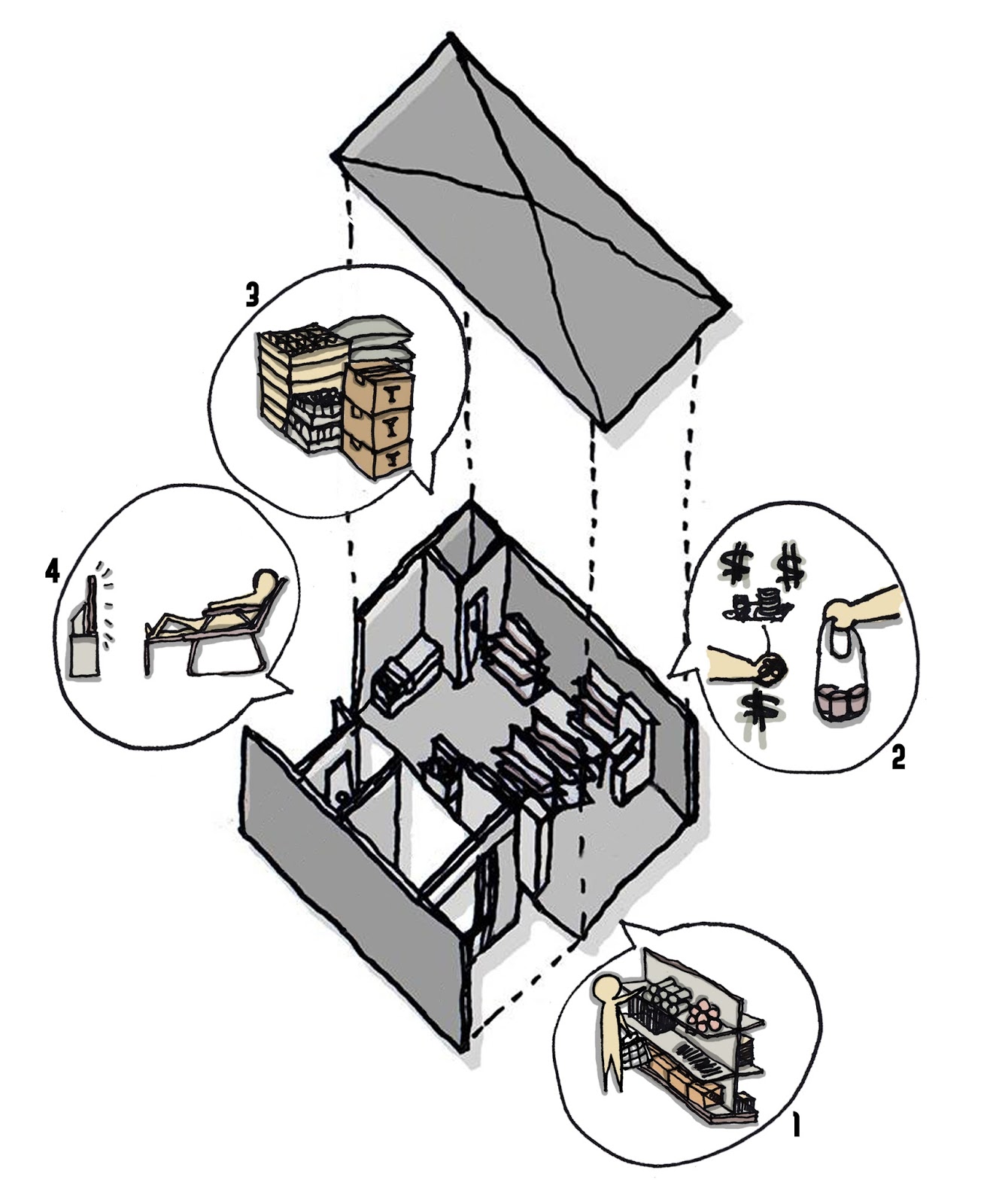
Activities in the kedai runcit


In the above diagram, what we did was pull out one of the main walls of the building along with the attached perpendicular partitions to show the function of the spaces more apparently.

1. Display area - items are laid out on shelves to be display and browsed by the customers.

2. Payment area - Items chosen are paid for.

3. Storage room - New stock are stored in the room and are replenished from time to time.

4. Rest area - Includes the small bedroom and TV area for the shop owner to relax and unwind when there are no customers.

Generally, the space is publicly for displaying and selling grocery with a small private area to lounge around when there are no customers around.

And that's it! Ahhh, a nice short post to complete Chapter Two of our blog, Chapter Three will be up soon enough so check back with us later. Cheerio!